Why Learn to Read Music?
Learning to read music is easier than most people think. A piece of music is simply a set of instructions which tells you how to play a particular tune or song - which notes to play, when to play them, and how long they should sound. You already know the names of some notes which you can play, and you have learned to fit them in with beats you count. The rest is not difficult to learn.
You could learn to play the guitar without reading music - if you have the flair for picking everything up very quickly by copying other players, or if you restrict yourself to basic backings for tunes you know well. However, you will be able to learn new songs and tunes more easily, quickly and correctly if you take a little time to learn to read music. Most guitarists find it is a real advantage. Many of those who do not learn when they started to play the guitar regret it later.
How Note Names Work
Notes are named after letters of the alphabet, and each note sounds higher than the note before it. Only seven letters are used in Western music - A, B, C, D, E, F and G. After G, the sequence repeats from A, but one octave higher. So the full sequence ascending is A B C D E F G A B C D E F G, and so on indefinitely.
Play the note g on the 1st string behind the 3rd fret and compare it with the 3rd string open, which is also called g. These notes sound very similar even though the g on the 3rd string sounds lower - they are the same note, just one octave apart.
The Stave and Treble Clef
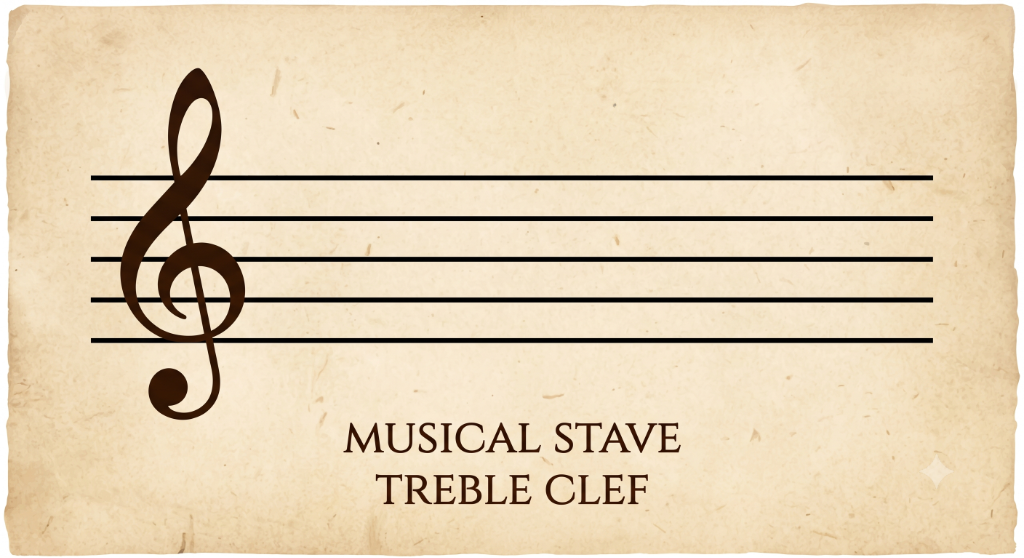
The Stave & Treble Clef: Five horizontal lines where notes are placed. The treble clef circles the G line.
Notes are written on a stave - a set of five horizontal lines. Each note has its place on one of the lines, or in one of the spaces between them. The lines do not represent the strings of the guitar.
At the beginning of each line of music there is a sign called a Treble Clef (or G Clef). This symbol marks the position of the note g on the second line up from the bottom. Once you know where g sits, you can work out all the other notes from it.
Going upward from the bottom of the stave: the note on the first space is d, the first line is e, the first space above that is f, the second line is g, the second space is a, the third line is b, and so on. Going downward, f is in the space just below g, and e is on the bottom line.
Note Values - How Long Notes Last
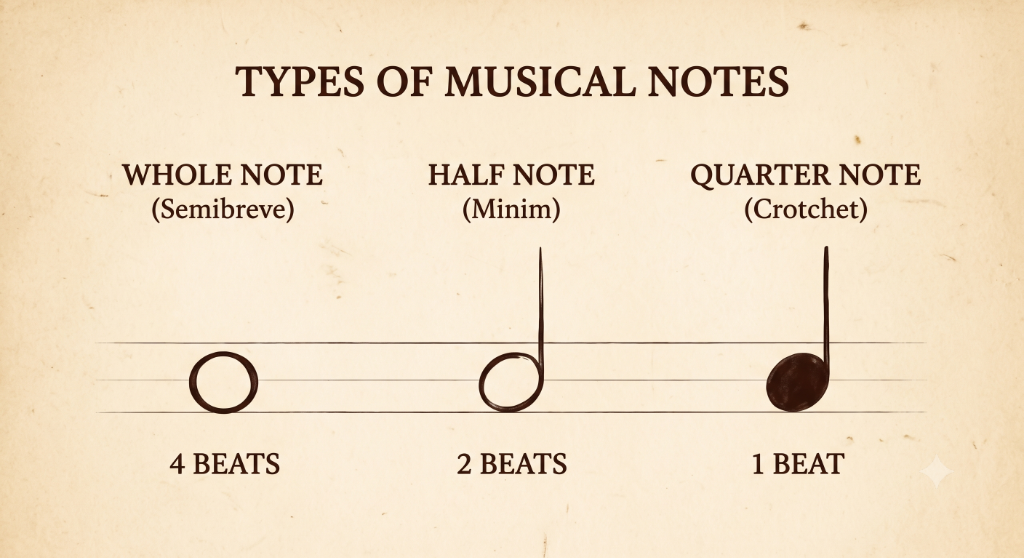
Note Values: Whole notes (4 beats), Half notes (2 beats), and Quarter notes (1 beat).
The shape of a note tells you how many beats it should last:
- A quarter note (filled notehead with a stem) - lasts 1 beat. This is the most common note value.
- A half note (open notehead with a stem) - lasts 2 beats.
- A whole note (open notehead, no stem) - lasts 4 beats.
You can count the beats and fit the notes in with your counting, exactly as you have been doing with the tunes you have been playing. Note stems can go up or down - this does not affect the note or its value.
✦ Practice Tip
Look through any piece of music and write the note names in pencil under each note before you try to play it. This is a standard learning technique used by guitar teachers worldwide. Then play the tune, and the note names will gradually become familiar. Erase the pencil marks once you can recognise the notes without help.
Understanding Rests (Silence in Music)
In music, silence is just as important as sound. A rest is a symbol that tells you to stop playing and let the music breathe for a specific amount of time. Just like notes, rests come in different values:
- Whole Rest: Looks like a heavy block hanging below the 4th line of the stave. It means four full beats of silence.
- Half Rest: Looks like a heavy block sitting on top of the 3rd line. It means two beats of silence.
- Quarter Rest: Looks like a squiggly zig-zag line. It means one beat of silence.
- Eighth Rest: Looks like a line with one flag on the left side. It means half a beat of silence.
When you see a rest, you must actively silence your guitar strings. If you just stop plucking but let the previous note keep ringing, you aren't actually playing a rest!
Time Signatures (The Musical Ruler)
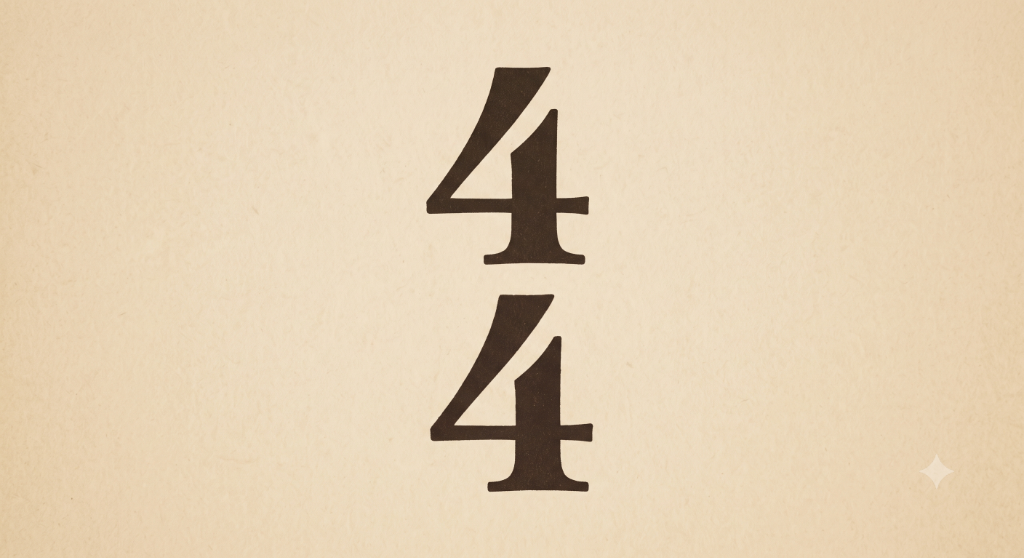
4/4 Time (Common Time): Four beats per measure, and the quarter note gets the beat.
At the very beginning of a piece of music, right after the treble clef, you will see two numbers stacked on top of each other, like a fraction (e.g., 4/4 or 3/4). This is the Time Signature.
The top number tells you how many beats are in each bar (the vertical lines that chop the music up into manageable blocks). The bottom number tells you what kind of note gets one beat. For beginners, the bottom number will almost always be a 4 (which stands for a quarter note).
So, 4/4 time (Common Time) means there are four quarter-note beats in every bar. You would count it as "1, 2, 3, 4 | 1, 2, 3, 4". 3/4 time (Waltz Time) means there are three quarter-note beats per bar, counted as "1, 2, 3 | 1, 2, 3".
Key Signatures (Sharps and Flats)
As you progress, you will start seeing sharp signs (♯) or flat signs (♭) placed right next to the treble clef at the start of a line. This cluster of symbols is called the Key Signature.
Instead of writing a sharp sign next to every single F note throughout a song, a composer will just put one sharp sign on the top line (the F line) at the very beginning of the piece. This rule means: "Every single F you see in this entire song must be played as an F#."
The Challenge of Guitar: Multiple Locations for One Note
A piano is linear; there is only one specific key for "Middle C". The guitar, however, is a two-dimensional grid. The exact same Middle C pitch can be played on the 5th string (3rd fret), the 6th string (8th fret), and sometimes even the 4th string (depending on the tuning).
This is why reading sheet music for the guitar is notoriously difficult compared to other instruments. When you see a note on the page, you don't just have to identify it—you have to make a split-second decision about which string makes the most sense to play it on, based on where your hand currently is.
Notes on All 6 Strings
The notes on each string in first position cover a specific range on the stave. The 4th, 5th and 6th strings produce notes that fall below the bottom line of the stave, so they are written on short extra lines called ledger lines. These work exactly the same way as the main stave lines.
The notes b, d from the 4th, 5th and 6th strings are found on ledger lines below the stave. The 4th string open is d, the 5th string open is A (below Middle C on the piano), and the 6th string open is E, the lowest note on a standard guitar.