Meet the Guitar
Before you play a single note, get to know the instrument you're holding. Understanding the parts of the guitar, how the strings and frets work, and which type of guitar suits you will make every lesson that follows much easier.

Before you play a single note, get to know the instrument you're holding. Understanding the parts of the guitar, how the strings and frets work, and which type of guitar suits you will make every lesson that follows much easier.
The guitar is one of the most popular instruments in the world, and for good reason. It's small enough to carry anywhere, versatile enough to suit any musical style - Pop, Folk, Country, Rock, Blues, Jazz, Classical - and you can start making music on it with no prior knowledge whatsoever.
It works beautifully on its own: you can play melody, harmony, and rhythm all at once. It works equally well inside a band, backing a vocalist, or playing solo. Whether you are a complete beginner or someone who already plays a little, there is always something new to discover on the guitar.
Work through each lesson in order, one at a time. Read everything before moving on. Don't skip ahead or jump around - every lesson builds on the one before it. The correct technique may feel harder at first, but it is always easier in the long run. Good habits formed now prevent bad habits that are very difficult to undo later.
Every guitar - acoustic, classical, or electric - shares the same core anatomy. Learning these names now means you'll understand every lesson, tutorial, and conversation with other players that follows.
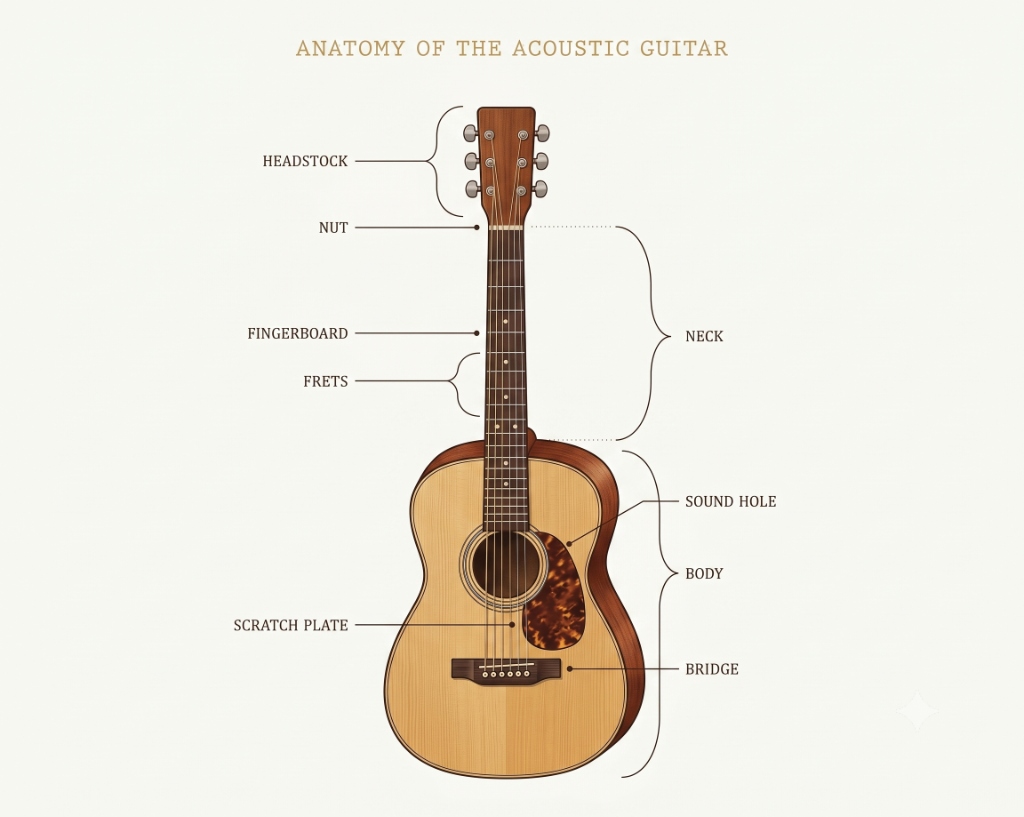
The large curved section you rest against your chest. On an acoustic guitar the body is hollow - the chamber amplifies the string vibrations and projects the sound out through the sound hole. The scratch plate (finger guard) protects the body's face from pick wear. Strings are anchored at the bridge, and the bridge bone (saddle) sets their height and intonation.
The long thin piece extending from the body. The front face is the fingerboard (fretboard), where your fretting hand presses the strings. Thin metal strips embedded across it are called frets. Pressing a string behind a fret shortens its vibrating length and raises the pitch. The heel is where the neck meets the body.
At the top of the neck sits the headstock. Strings run over the nut - a small grooved piece of bone or plastic - and wind around the tuning pegs (machine heads). Turning a peg clockwise tightens the string and raises its pitch; counter-clockwise loosens it and lowers the pitch.
A standard guitar has six strings numbered 1 to 6. String 1 is the thinnest and highest in pitch - closest to the floor when holding the guitar. String 6 is the thickest and lowest in pitch - closest to the ceiling. The standard tuning from thickest to thinnest is E · A · D · G · B · E.
| String | Note | Type | Position |
|---|---|---|---|
| 6 | E (low) | Thickest - wound wire | Nearest the ceiling |
| 5 | A | Thick - wound wire | |
| 4 | D | Medium - wound wire | |
| 3 | G | Medium | |
| 2 | B | Thin - plain | |
| 1 | E (high) | Thinnest - plain | Nearest the floor |
Memory trick (thickest to thinnest): Eddie Ate Dynamite, Good Bye Eddie - E · A · D · G · B · E
Guitars are built specifically for one string type. They are not interchangeable - using the wrong type can permanently damage the instrument.
Produce a warm, mellow tone and are gentler on fingertips - a real comfort advantage for beginners. Strings 1, 2, and 3 are a single nylon strand. Strings 4, 5, and 6 are nylon cores wound with silver or bronze-plated copper wire.
Brighter and louder than nylon. Slightly tougher on fingertips at first but calluses build quickly with regular practice. Strings 1 and 2 are plain nickel-plated steel. Strings 3 through 6 are wound with wire for added mass.
Never fit steel strings to a guitar built for nylon - the extra tension can warp the neck and damage the body. Fitting nylon strings to a steel-string guitar produces a weak, dead tone. When in doubt about which strings your guitar needs, ask at any music shop before buying.
There are four main types of guitar. Understanding them helps you buy confidently - or know what you already own.
Suited to classical solo playing, Flamenco, and fingerstyle. Always played with the fingers - no plectrum. Wide neck, warm tone. Flamenco variant has tap plates for percussive strikes.
The all-purpose guitar. Suits Pop, Folk, Country, Rock, Blues, and more. Can be fingerpicked or strummed with a plectrum. No amplifier needed. The Jumbo version has a deeper body for fuller bass.
✦ Best First GuitarSlim hollow body gives a little un-amplified sound for practice, but designed for an amp. Lighter than a solid guitar, often with a warmer amplified tone. Great for Jazz, Blues, and vintage rock.
No acoustic volume - needs an amplifier. Made in many shapes and styles. Low action makes it physically easy to play fast. Ideal for Rock, Metal, Pop. Factor in the cost of amp, cable, and tuner.
For most beginners a steel-string roundhole acoustic is the smartest first guitar - no amp needed, widely available, suits almost any style. But if your goal is rock or electric blues, starting on electric is completely valid. The guitar that excites you most is almost always the right choice, because motivation is everything in the early stages.
When you look at acoustic guitars, you will quickly notice they come in several different shapes and sizes. The body shape drastically affects both how the guitar sounds and how comfortable it is to hold. The most common shape is the Dreadnought, which has a large, wide body. It produces a loud, booming sound with strong bass frequencies, making it perfect for strumming and playing in a band. However, its large size can be uncomfortable for smaller players or children.
If a Dreadnought feels too bulky, a Concert or Auditorium size might be perfect. These have a narrower waist (the pinched middle section) and a slightly shallower body. They sit very comfortably on the lap and produce a more balanced, articulate tone that fingerstyle players love. For even smaller options, Parlor guitars offer a compact, vintage-style body that is exceptionally comfortable to play on the sofa, though they lack the deep bass of larger instruments.
While this course primarily focuses on acoustic guitar fundamentals, many beginners wonder if they should start on an electric guitar instead. Both are perfectly valid starting points, and the skills you learn on one transfer directly to the other. The biggest physical difference is that electric guitars use solid bodies and magnetic pickups to capture the string vibrations, which are then sent to an amplifier via a cable.
Because electric guitars don't need a hollow body to project sound, their strings can be much thinner and placed closer to the fretboard. This makes electric guitars significantly easier on beginner fingertips. However, an acoustic guitar is "grab and go"—you don't need to plug it in, find a power outlet, or adjust amplifier settings to get a great sound. You can play an acoustic anywhere, from your bedroom to a campfire.
The type of wood used to build an acoustic guitar—known as "tonewood"—has a massive impact on its final sound. The most important piece of wood on an acoustic guitar is the top (or soundboard). Spruce is the most common top wood; it looks pale yellow and produces a bright, clear, and loud sound. Mahogany tops are darker brown and produce a warmer, earthier tone with a strong midrange.
The back and sides of the guitar also matter. Rosewood backs provide a rich, dark sound with sparkling highs, while mahogany backs offer a more focused, punchy sound. While beginners shouldn't stress too much about tonewoods when buying their first instrument, understanding that different woods sound different helps explain why two guitars of the exact same shape can sound completely unique.
When you bring your first guitar home, you need a few essential tools to get started properly. The most critical accessory is a clip-on electronic tuner. Guitars go out of tune constantly due to temperature changes and playing, and tuning by ear takes months to learn. A clip-on tuner attaches to the headstock and tells you exactly when the string is perfectly in tune.
You will also want a variety of guitar picks (plectrums). Start with thin or medium picks (around 0.60mm to 0.73mm), as they bend easily and make strumming feel much smoother for beginners. A guitar stand or wall hanger is also highly recommended. If your guitar is packed away in a case in the closet, you will practice far less. If it is sitting on a stand in your living room, you will pick it up every day.
Now that you know your instrument, Lesson 02 covers how to choose and buy the right guitar - what to look for in a shop, how to test one before buying, secondhand options, and the questions worth asking before you spend your money.
Everything beginners ask about the guitar before picking one up
From thickest to thinnest the six strings are E, A, D, G, B, E - often written as EADGBE. String 6 (low E) is the thickest and closest to the ceiling when you hold the guitar. String 1 (high E) is the thinnest, closest to the floor. A handy memory trick: Eddie Ate Dynamite, Good Bye Eddie.
The main parts are: headstock (top, holds tuning pegs), nut (small grooved strip at top of neck), neck, fingerboard / fretboard (front face of neck), frets (metal strips across neck), body (large curved section), sound hole (on acoustic guitars), bridge (anchors strings to body), saddle / bridge bone (sets string height), and scratch plate (protects body from pick wear).
Nylon strings give a warm, mellow tone and are easier on fingertips - used on classical and flamenco guitars. Steel strings are brighter and louder - used on acoustic and electric guitars. The two types are not interchangeable. A guitar is built for one specific string type; fitting the wrong ones can warp the neck or damage the body.
A steel-string roundhole acoustic guitar is the most practical first guitar for most people - no amplifier needed, affordable, and suitable for nearly every style. That said, if your heart is set on rock or electric music, starting on an electric guitar is completely valid. The most important factor is choosing the instrument that motivates you to practice every day.
Frets are thin metal strips embedded across the fingerboard. Each fret raises the pitch of a string by one semitone (half step). When you press a string down behind a fret, you shorten the vibrating portion of the string, which makes the pitch higher. Fret 1 is closest to the headstock. Fret 12 produces the same note as the open string, but exactly one octave higher.
Standard guitar tuning from thickest string to thinnest is E A D G B E. The low E (string 6) is the deepest and the high E (string 1) is the highest. This is called "standard tuning" or "EADGBE tuning" and is how almost all beginner lessons and chord charts are written. You can tune with a clip-on tuner, a tuner app, or by ear.
No - never. Steel strings create far more tension than nylon strings. Fitting them to a classical guitar can warp the neck, pull the bridge away from the body, and cause permanent damage. Always use the string type your guitar was designed for. If you are unsure, check with your local music shop before buying strings.
An acoustic guitar has a hollow body that amplifies sound naturally through the sound hole - no electricity or amplifier needed. An electric guitar has a solid or semi-hollow body with magnetic pickups that convert string vibrations into an electrical signal, which is then sent to an amplifier. Electric guitars typically have thinner strings and lower action, making them physically easier to press down.