First Guitar Notes & Tunes
With just a few notes you can already play real tunes. This lesson teaches all the essential notes on the first three strings and puts them together in simple melodies you can actually recognise.

With just a few notes you can already play real tunes. This lesson teaches all the essential notes on the first three strings and puts them together in simple melodies you can actually recognise.
You have already learned three notes on the 1st (thinnest) string. To recap:
Practise playing these three notes slowly, one at a time, counting the beats as you play. Always use the correct finger - 1st finger for fret 1, 3rd finger for fret 3. Keep your left thumb straight against the back of the neck.
The 2nd string gives you three new notes - b, c, and d:
To play the note c, you need to press the 1st finger flat across both the 1st and 2nd strings simultaneously - this is because both the f note (on the 1st string) and the c note (on the 2nd string) use the 1st finger at the 1st fret position. When you press the 1st finger for c, make sure it is not touching the 3rd string at all, or that string will be muted.
Always keep your fingers on each note until the next finger is ready to move. This is called "walking" your fingers - professional guitarists do this naturally. It helps your playing sound smooth and avoids any gaps between notes.
The 3rd string adds two more notes:
Play the notes on the 1st, 2nd and 3rd strings one after the other in sequence - you already know most of them: g, a, b, c, d, e, f, g. This runs from the open 3rd string all the way up to the 3rd fret of the 1st string, covering one complete octave of the musical alphabet.
With these notes you can now play real recognisable tunes. Before you start any tune, sing or hum the first few notes to yourself so you know how it sounds and can start counting at the right speed. Always tap your foot in time with the beat as you play.
Some notes last longer than others - this is shown in the notation by the spacing between them. When you see a note that lasts two or more beats, hold it down and let it ring while you count those beats before moving on.
Count evenly through bar lines as if they were not there. Count 1 2 3 4 1 2 3 4 continuously. Never slow down at a bar line - this is one of the most common beginner mistakes. Keep the beat rock steady throughout.
In this course, note names are shown in small lower-case letters (e, f, g) so they are not confused with chord names (which use capital letters: C, G, Am). This is standard practice in guitar teaching. The musical alphabet uses only seven letters - A B C D E F G - and then repeats. After G, the next note is A again, but it sounds an octave higher.

When playing single notes without a pick, use the pad of your right thumb to push down on the string in a downward motion. The thumb should move freely from the knuckle joint, not stiffly from the wrist. After striking the string, allow the thumb to come to rest lightly against the next string below. This is called a rest stroke and it gives you a full, resonant sound on each note.
Keep the rest of your right-hand fingers curled loosely near the soundhole rather than hanging free in the air. This gives your hand a stable anchor and prevents unnecessary movement. Your tone improves significantly once your right hand has a fixed, confident position.
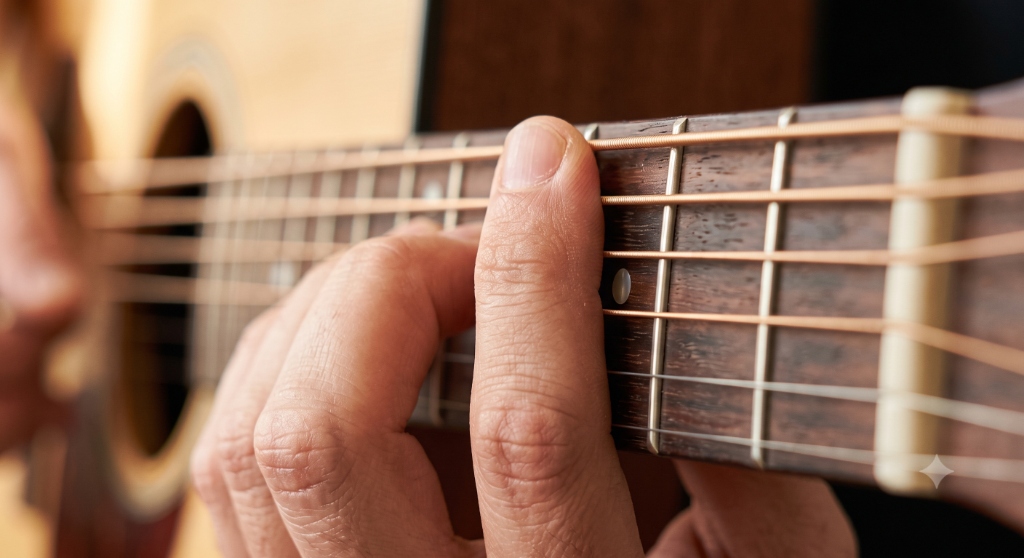
Each left-hand finger has a numbered name: the index finger is finger 1, the middle finger is finger 2, the ring finger is finger 3, and the little finger is finger 4. When a piece of music says "finger 2 on fret 3," you know exactly which finger goes where.
Always press your fingertip down just behind the fret, not on top of it or too far back from it. Pressing on top of the fret produces buzzing because the string cannot vibrate cleanly. Pressing too far back requires much more pressure to get a clear note. Just behind the fret is the sweet spot: the note rings clearly with minimal effort.
Keep your thumb roughly behind the 2nd or 3rd finger on the back of the neck. This gives your fingers the reach they need across the strings. Do not wrap your thumb over the top of the neck as this collapses your hand position and prevents your fingers from reaching all the strings efficiently.
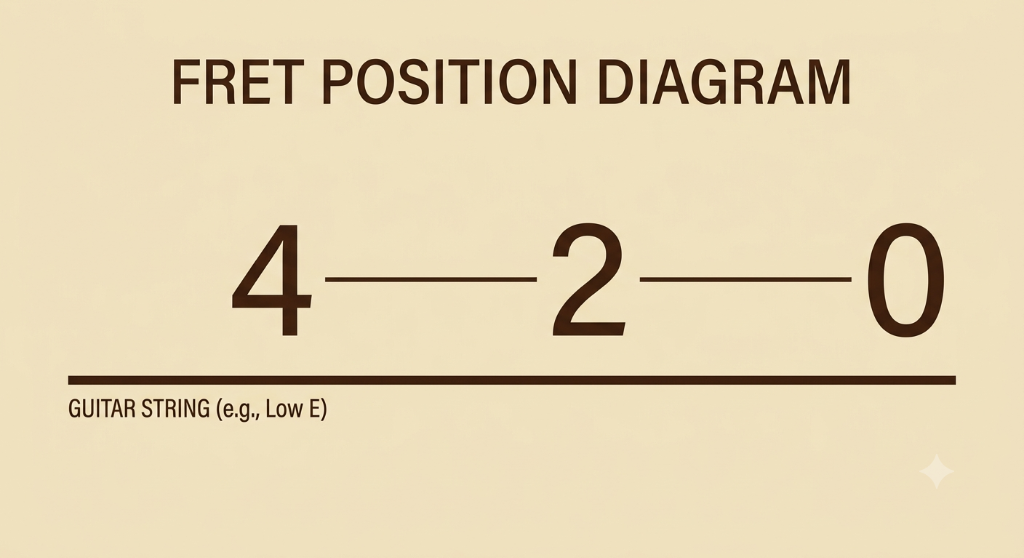
The classic beginner tune "Hot Cross Buns" uses only three notes and fits perfectly on the first two strings. On the B string (2nd string): open B, then 1st fret C, 2nd fret D. The melody goes: D, C, B (repeat), then four Bs, four Cs, then D, C, B. Play each note by pressing your left-hand finger just behind the fret while your right thumb pushes gently down on the string.
Count four beats as you play: "one, two, three, four." Each note in Hot Cross Buns gets one beat. When you can play through it twice without stopping or hesitating, try playing it along with a metronome set to 60 BPM. This is how you turn a simple exercise into real musical performance.
One of the earliest challenges for beginners is moving from one string to another without making noise on the string you are leaving. The key is to lift your left-hand finger and move your right-hand thumb to the new string at exactly the same moment. Practise moving slowly from the B string to the G string and back, keeping both hands perfectly synchronised.
If you hear a scraping or buzzing sound as you change strings, it usually means your left hand is either moving too slowly (still pressing when the right hand has moved) or too quickly (lifting off before the note has fully sounded). The two hands need to work as a team from the very first note.
As you play each note in your early tunes, say its name out loud: "D... C... B... B... B... B." This builds a connection between the physical position on the fretboard, the sound you hear, and the name of the note. Guitarists who learn note names early have a much easier time understanding chord theory and communicating with other musicians later on.
Now that you can play single notes clearly and put them together in time, the next step is combining them. In the next chapter, you'll learn how to play multiple notes at once to form your very first guitar chords!
Everything beginners ask before buying their first guitar
Your first guitar does not need to be expensive, but avoid the very cheapest instruments as they are often poor value and genuinely hard to play. A mid-range guitar will be much easier to learn on and will stay playable as you improve. Spending a little more gets you an instrument suitable for both learning and fairly advanced playing.
Secondhand guitars can be excellent value - but only if you know what to look for. Unless you are already experienced, buy from a reputable music shop rather than a private seller. Take an experienced guitarist with you and use the 7-point checklist to inspect it thoroughly before purchasing.
Check: (1) fingerboard is straight, (2) string height is correct at nut and 12th fret, (3) every note rings clearly without buzzing, (4) frets are not badly worn, (5) all tuning pegs work smoothly, (6) no cracks or splits anywhere on the body, and (7) for electric guitars, all electronics work correctly.
Yes, for acoustic guitars. As a general rule, the lighter the acoustic guitar the better its tone - excess wood mass can deaden the sound. Always compare the weight of several guitars of the same type before deciding. For solid electric guitars, weight affects comfort more than tone, but a very heavy instrument becomes tiring over long sessions.
Adults should always buy a full-size guitar. Three-quarter size guitars are for small children - generally under ten or eleven years old. The fingerboard width also matters: for general playing, the fingerboard should be at least 45mm (1¾ inches) wide at the nut. Avoid guitars with very narrow fingerboards if you have large hands.
Pick up a guitar pitch pipe or E tuning fork, a spare set of the correct strings, and the best guitar case you can afford. A hard case in wood or fibreglass offers the best protection. Ask the shop to tune the guitar before you leave, and keep your receipt somewhere safe.